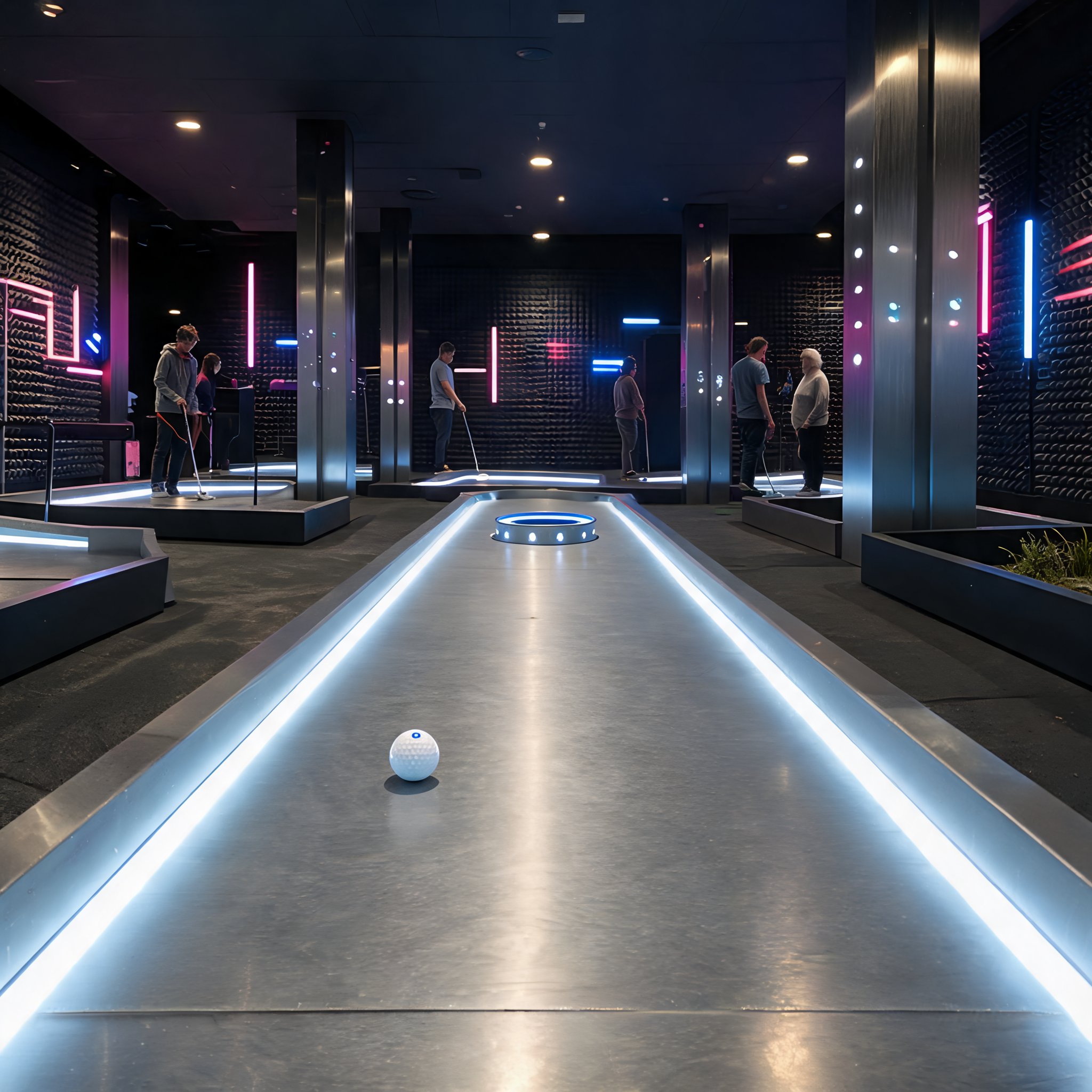
Holovis is positioning 360Golf as more than a technology-enabled mini-golf course: it is a connected gaming platform for the competitive socialising market. The format combines a familiar putting game with automated scoring, gamified challenges and an analytics layer intended to help operators manage venues and generate secondary spending. Holovis is preparing to showcase 360Golf at IAAPA Expo, and the team says implementations already span the UK, Europe, the Middle East, North America and Asia Pacific.
A familiar game with a digital layer
360Golf's starting point is mini golf's accessibility. Stuart Edgington, global director of business development, says the game does not need its fundamental appeal reinvented because most markets already understand it; technology is used to make play more competitive, interactive and commercially measurable. Visitors of all ages can register, collect an assigned smart ball and begin playing with little explanation or staff time. That matters for operators seeking intergenerational appeal: the same attraction can serve families, competitive-socialising young adults and corporate groups.
The scoring system is the platform's foundation. Smart balls, tees and cups work with HoloTrac to remove paper scorecards and act as a referee during close competition. On top of that, 360Golf adds SuperShots for alternative scoring, Triumphs that present awards and unlock challenges, plus bonuses, on-course games, player accounts, achievements, leaderboards and video celebrations. Matt Dobbs, business development director, says these features give players more reason to compete, celebrate, compare scores and return.
Analytics as an operating tool
Player activity feeds DeepSmarts, an AI analytics engine that Holovis says can support product development and venue operations. The system can provide insight into uptime, player interactions, seasonality and possible operational adjustments, and Holovis can offer this as an additional service. The attraction is designed to increase dwell time and secondary spend, with capacity of up to 80 people per hour per course. Dobbs describes the guest flow as a major advantage: visitors can use a kiosk, understand how to play, collect a ball and start, leaving staff to manage guests and food and drink. Happier guests, he argues, spend more, which supports F&B revenue.
The data also has a commercial use beyond day-to-day operations. Operators can target promotions at quieter periods or underserved groups. The equipment is designed for maintenance by the venue, with a repairable approach intended to extend longevity and sustainability; if something goes wrong, DeepSmarts can help engineers diagnose issues remotely. For multi-site operators such as Saudi Entertainment Ventures, the technology provides a common basis for consistency while allowing variation in theming, layout or branding. Edgington says clients including SEVEN and Super Social in Ireland are looking for repeat visitation, and the scoring and dynamic gameplay support that model.
Flexible formats and delivery
360Golf is offered as a tech-only package that can be retrofitted into existing mini-golf attractions, as catalogue holes, or as fully bespoke course development. Timelines vary accordingly: tech-only deployments take about six to eight weeks, catalogue holes eight to 12 weeks, and custom courses upwards of six months. Netflix House's Top 9 course is a fully custom, IP-led installation with unique holes and multiple interactive elements, including themes such as One Piece, Squid Game and Floor is Lava. Norwegian Cruise Line's Tee Time courses required marine-grade customisation: four installations use IP-rated technology, rugged cups and tees and specialist screens to deliver the same experience at sea. Smaller venues can choose a more cost-effective design while retaining scoring and replayability.
Installation evidence and inclusive design
At Butlin's Bognor Regis resort, the £15m PLAYXPERIENCE indoor activity centre, opened in 2024, includes three nine-hole 360Golf courses: one with neon glow effects, a Las Vegas-themed course and a wheelchair-accessible music-themed course. Dobbs says the tech-putt offer exceeded the client's expectations, with about 5,000 players a week and around £40,000 in weekly revenue during busy weeks. The project also deepened the team's work on inclusive design, from putters for right- and left-handed players and tall guests to wheelchair access and enough spacing between holes to reduce crowding and safety hazards.
Newer work continues in the same direction. Lucky Duck in Norway has a fully customised course with two routes for each hole, adding a further layer of play and making use of available space. Holovis is also working with Roxy Leisure to add stroke-counting technology to crazy pool tables, and Maaz Ussen, project manager, says the ambition is to apply the technology to other sports. These are development and integration projects rather than proven scale markets.
What the model depends on
The proposition rests on a simple contrast: a familiar social game lowers the barrier to entry, while connected scoring and gamification create reasons to return. That combination can help operators increase throughput and secondary spend, but the commercial result still depends on venue layout, guest flow, staffing, pricing and how actively operators use the data. The flexibility to serve retrofits, catalogue courses and custom installations broadens the potential market, though custom work adds time and complexity. Holovis presents strong operator examples from Butlin's and a growing global footprint, but the figures cited are company-selected examples rather than a broad performance benchmark. The next phase of growth will test whether 360Golf can keep improving engagement through AI and gamification, and whether its technology can travel into adjacent sports without losing the simplicity that makes mini golf easy to pick up.