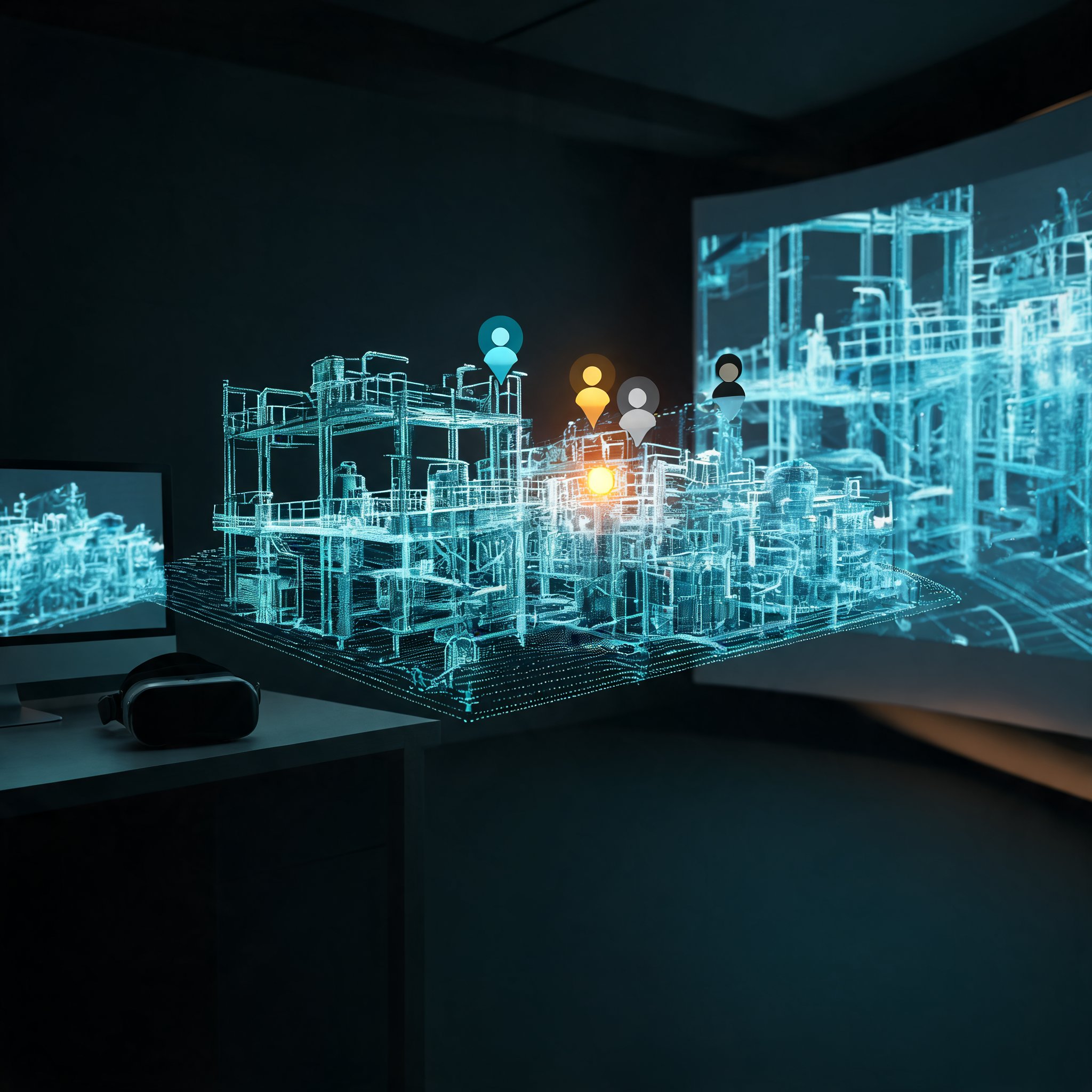
Cintoo has launched Cintoo Workspace, a collaborative environment for reviewing detailed digital twins delivered as a live stream from 3D scan data. The company says project teams can meet in real time from a desktop, a VR headset or an immersive room and make decisions inside the digital twin rather than through a chain of screen shares, emails and later site visits.
The product is an Unreal Engine application connected through the cloud to the Cintoo platform. It works with scan data from terrestrial and mobile scanners, 360 cameras and drones, and can combine that reality capture with BIM or CAD models. That lets users examine the site as captured and compare existing conditions with the design intent, Cintoo says.
Guided review instead of an unstructured 3D meeting
Cintoo frames the central problem as coordination, not simply access to 3D data. Organizations are collecting more reality data, but the specialists who need to review it are often in different locations. Shared 3D spaces can become unstructured meetings in which participants lose track of one another, while video calls tend to leave most attendees watching one person’s low-resolution walkthrough, according to the company.
Workspace introduces a guided collaboration model intended to resemble a site walk. One person leads the review. Other participants can choose to follow the leader while retaining the ability to explore independently, and the leader can bring the group to a specific location when an issue needs attention. Role indicators, avatars and a radar view are designed to keep participants oriented.
Annotations and decisions in context
Within the shared session, teams can use annotations, measurements and issue features. Cintoo positions these tools as a way to move discussion and decisions into the digital twin, where the relevant site condition is visible, instead of deferring them to separate emails or meetings. The same environment supports different participation modes, from a desktop to a VR headset or an immersive room, so users can join with the device available to them.
Dace Campbell, Cintoo’s Product & Business Manager for XR & Metaverse, said that occupying the same 3D space is not the same as working together. He said teams need the structure of a real site walk, in which someone leads, participants can break away to inspect details and the group can regroup to discuss. Carrying out that process in real scan data and on the user’s preferred device is, in Cintoo’s view, what makes remote reviews work and supports faster, more confident decisions.
The launch adds a real-time review layer to Cintoo’s reality-capture platform. Its practical value will depend on how teams adopt the guided-session format and integrate scan-based reviews into existing project workflows; the announcement does not provide independently verified productivity or cost results. The announcement did not include pricing or rollout details.