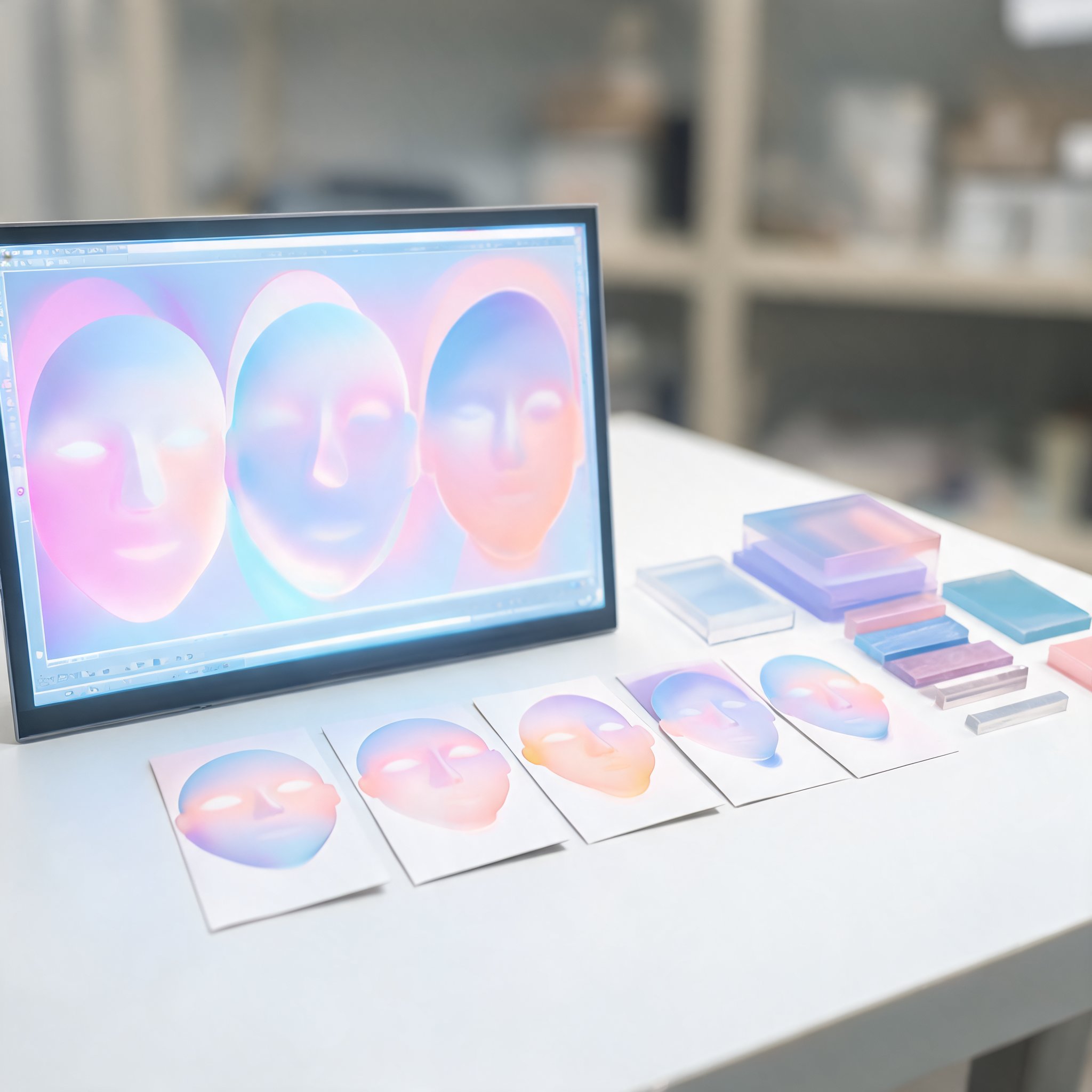
LAIKA has signed an agreement with Prague-based software developer Additive Appearance to make its PrismSlicer renderer available to the stop-motion studio’s artists. The tool is intended to show how color and translucency will appear in a PolyJet print before a part is produced, so that digital designs and physical faces can be matched more predictably.
The mismatch between what appears on a screen and what emerges from a full-color 3D printer is a persistent production problem: each discrepancy can require another print. LAIKA produces hundreds of thousands of detailed faces for each film, so fewer reprints would affect both production time and quality assurance.
Previewing appearance before fabrication
PrismSlicer generates an initial preview of a model’s color, translucency and surface appearance before printing. It can include LAIKA’s custom studio lighting environments, with the goal of reducing print iterations. Robert Ducey, technical supervisor at LAIKA, said the software has the potential to give artists predictive previews of digital designs under the studio’s lighting, adding that reliable, fast renders could significantly reduce development time. The statement describes potential rather than a measured outcome.
Initial projections indicate that the visualizations could lower the number of print iterations and improve artist satisfaction through faster feedback. Those are projections, not confirmed production results.
Trial and software development
The agreement targets a predictable match between on-screen designs and printed parts, and the companies frame it around a seven-month trial against production criteria. During that period, PrismSlicer gained a command-line interface to support automation, while its simulation backend received features intended to make renders more realistic.
Additive Appearance is a spin-off of Charles University in Prague, and its team consists of engineers and researchers. The LAIKA partnership builds on joint development and material research with the university’s Computer Graphics Group. That work addresses two problems: optically measuring materials used in PolyJet 3D printing, and precisely matching photographs to renderings. The company says its tools are designed for a range of hardware platforms and industries. Tobias Rittig, CTO of Additive Appearance, said LAIKA’s trust validates the company’s mission to make full-color 3D printing as predictable and expressive as 2D imaging.
LAIKA’s color-matching history
LAIKA has previously pursued appearance fidelity in PolyJet printing. For Missing Link, it combined Stratasys J750 printers with the Cuttlefish 3D printer driver from Fraunhofer IGD to produce more than 106,000 facial expressions. Brian McLean, then LAIKA’s director of rapid prototype, attributed the choice to the software’s color consistency and geometric accuracy. Cuttlefish is a voxel-based driver that works with multiple materials at once and accounts for light dispersion, hue and surface texture.
Stratasys took a different approach when its J735 and J750 PolyJet printers received Pantone validation in 2019. The Pantone Matching System was integrated into the printers’ workflow so designers could choose colors from a shared reference palette and reduce misinterpretation. That method standardizes color selection against a reference, whereas PrismSlicer renders how a specific model is expected to look once printed.
LAIKA, founded in 2005 outside Portland, Oregon, received a Scientific and Technology Oscar in 2016 for its work in 3D printing. Its newest feature, Wildwood, opens on October 23, and the studio said it selected PrismSlicer with future productions in mind. Both teams expect the collaboration to lead to further work in full-color 3D printing, including new ways to combine digital and physical workflows in creative production.