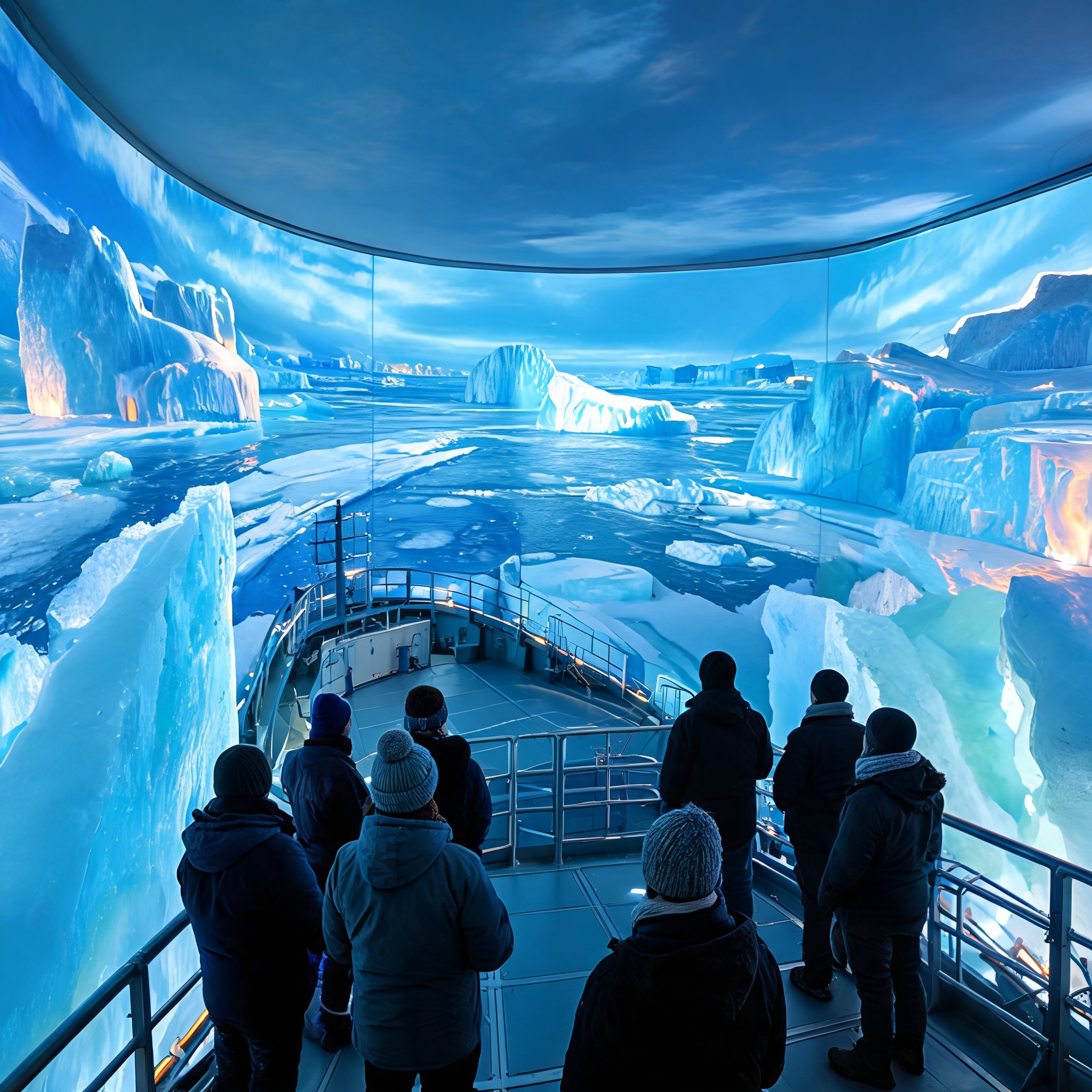
Polar Experience, an immersive exhibition focused on the Arctic and Antarctic, is designed to place visitors inside a contemporary research expedition rather than present climate change only through statistics. The project was conceived by Nicole Srock.Stanley and developed by dan pearlman. It is presented by Galileo and Galileo Kids, with the Alfred Wegener Institute, Helmholtz Centre for Polar and Marine Research, as scientific partner and WWF Germany contributing content expertise.
The visitor route follows a single expedition narrative. It starts with boarding the research vessel Polarstern, where guests are treated as expedition members before moving into simulated frozen landscapes. Along the way, the exhibition presents ice formations, polar wildlife and the lives of Indigenous communities, and it explores scientific missions that have shaped understanding of climate change. The journey ends in a 360-degree projection space that combines large-scale imagery, surround sound and choreographed storytelling.
Science as the foundation
According to the project team, scientific accuracy is the base layer of the exhibition, not an add-on. Research from the Alfred Wegener Institute and polar researcher Prof. Dr. Markus Rex informed the stories, environments and installations. The aim is to translate complex climate research into an accessible experience for audiences of different ages and levels of prior knowledge, while keeping the underlying science credible.
The exhibition also uses a layered approach to accessibility. A multilingual audio guide accompanies the full route, and younger visitors are guided by Cosmo, a character from Galileo Kids. Organizers say this allows families, school groups and adults to engage with the material at their own level without simplifying the content to the point of losing accuracy. The design combines authentic research, emotional storytelling and interactive participation.
From spectacle to participation
Polar Experience is positioned as an example of immersive media moving beyond spectacle. The project team says it deliberately avoids fear-based messaging and instead aims to build curiosity, wonder and optimism. The final Act Now area turns the exhibition's themes toward practical climate engagement, partnerships and personal contribution. The stated goal is for visitors to leave with a stronger sense of responsibility and agency, though the exhibition's long-term behavioral impact is not quantified in the project description.
Development involved scientists, filmmakers, Indigenous representatives, educators, media partners, designers and immersive technology specialists. According to the project, scientific expertise shaped the exhibition from its earliest stages rather than being applied after the creative concept was finished. That interdisciplinary process was intended to produce an experience that is both emotionally engaging and scientifically trustworthy.
Premiere response and partners
During its world premiere in Berlin, Polar Experience welcomed more than 120,000 visitors in four months, according to the project team, and drew praise from audiences and media. The exhibition is presented by Galileo and Galileo Kids. Local promoters are FKP Scorpio Entertainment in Oberhausen and Cofo Entertainment in Berlin. Seven.One Starwatch, a subsidiary of ProSiebenSat.1 Media SE, is media partner, and GLS Bank supports the project as sponsor.